Advances in Plant Allelopathy
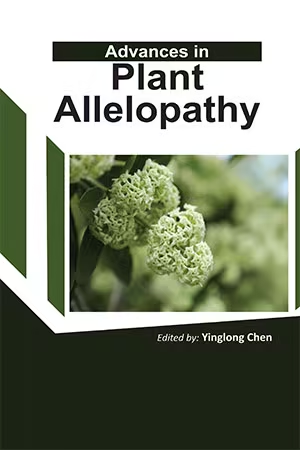
Yinglong Chen | 2023 | ISBN: 1682518957 | English | 272 pages | True PDF | 13 MB
The concept of "allelopathy" was first proposed by Austrian scientist Hans Molisch in 1937 and mainly referred to the chemical relationship of plant interaction. Allelopathy is an ecological phenomenon and plays an important role in the ecological adaptation of plants. The allelopathic effects have both positive and negative effects. Various studies have reported the advantages of allelopathic effects in agricultural systems, such as weed control, inhibition of pests, disease, improvement of soil nutrition, and microbial interactions. Ultimately, allelopathy of most plants has effect on plant growth. Plants can synthesize various secondary metabolites during growth and development. Many of the compounds considered to be allelochemicals have little or no biological activity in plants in soils due to their instability, rapid degradation and interaction with the soil. Therefore, the soil plays an important role in allelopathy. Another area of needed research is microbial involvement in allelopathy. Soil microbes can degrade allelochemicals and also transform less phytotoxic compounds to more phytotoxic ones. It has also been found that allelochemicals change the soil microflora populations and compositions. Plant allelopathy is one of the modes of interaction between receptor and donor plants and may exert either positive effects (e.g., for agricultural management, such as weed control, crop protection, or crop re-establishment) or negative effects. To ensure sustainable agricultural development, it is important to exploit cultivation systems that take advantage of the stimulatory/inhibitory influence of allelopathic plants to regulate plant growth and development and to avoid allelopathic autotoxicity. Allelochemicals can potentially be used as growth regulators, herbicides, insecticides, and antimicrobial crop protection products.
This book presents the plant allelopathy management practices applied in agriculture and the underlying allelopathic mechanisms. The major points addressed are as follows: Description of management practices related to allelopathy and allelochemicals in agriculture. Discussion of the progress regarding the mode of action of allelochemicals and the physiological mechanisms of allelopathy, consisting of the influence on cell micro- and ultra-structure, cell division and elongation, membrane permeability, oxidative and antioxidant systems, growth regulation systems, respiration, enzyme synthesis and metabolism, photosynthesis, mineral ion uptake, protein and nucleic acid synthesis. Allelopathy is an ecological phenomenon in which organisms interfere with each other. As a management strategy in agricultural systems, allelopathy can be mainly used to control weeds, resist pests, and disease and improve the interaction of soil nutrition and microorganisms. Volatile organic compounds (VOCs) are allelochemicals volatilized from plants and have been widely demonstrated to have different ecological functions. This book provides the recent advance in the allelopathic effects of VOCs on plants, such as growth, competition, dormancy, resistance of diseases and insect pests, content of reactive oxygen species (ROS), enzyme activity, respiration, and photosynthesis. VOCs also participate in plant to-plant communication as a signal ing substance.
Quick check before we show the links
Helps us keep automated scrapers from hammering the filehosts.