Web-Based 3D Terrain & Industrial Printing Engine Mastery
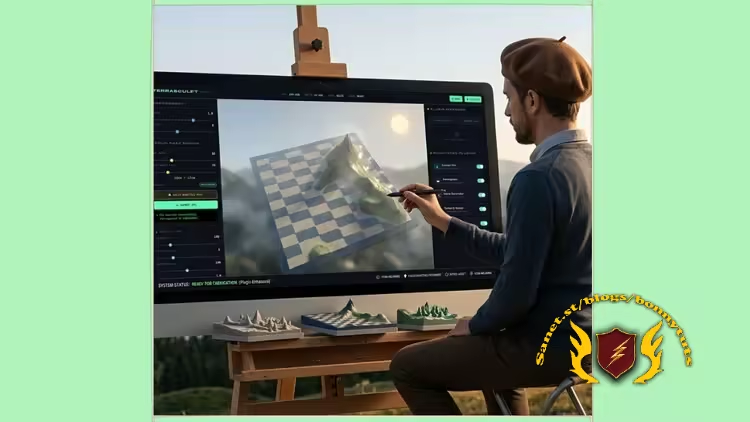
Published 5/2026
Created by Okan Kaplan
MP4 | Video: h264, 1920x1080 | Audio: AAC, 44.1 KHz, 2 Ch
Level: Intermediate | Genre: eLearning | Language: English | Duration: 31 Lectures ( 2h 36m ) | Size: 3.1 GB
Build GPU-Powered WebGL Terrain Systems, Procedural Worlds, Real-Time Simulation, Sculpting Tools, and STL Export Pipeli
What you'll learn
⚡ Build a high-performance WebGL-based 3D terrain rendering engine from scratch
⚡ Design GPU-optimized architectures using BufferGeometry, Float32 memory models, and batching systems
⚡ Develop advanced interaction systems including real-time sculpting, raycasting, and undo/redo mechanics
⚡ Implement procedural terrain generation, erosion simulation, and river formation systems
⚡ Create ecosystem systems using GPU instancing and terrain-aware procedural placement
⚡ Export watertight 3D models as STL files and prepare them for real-world 3D printing using slicer software.
⚡ Develop a full industrial pipeline that converts digital terrain into watertight, 3D-printable STL models
Requirements
❗ Basic knowledge of JavaScript (variables, functions, arrays, loops)
❗ Familiarity with HTML/CSS and using a code editor (VS Code recommended)
❗ A computer capable of running modern web browsers (Chrome, Edge, or Firefox)
❗ No prior 3D or Three.js experience required — everything will be taught step by step
❗ Basic understanding of math concepts (coordinates, vectors) is helpful but not mandatory
❗ Optional: Access to a 3D printer or slicer software (Cura/PrusaSlicer) for the final export stage
Description
Course Title (≤ 60 characters)
Web-Based 3D Terrain & Industrial Printing Engine Mastery
What students will learn
By the end of this course, students will be able to
✨ Build a high-performance WebGL-based 3D terrain rendering engine from scratch
✨ Design GPU-optimized architectures using BufferGeometry, Float32 memory models, and batching systems
✨ Develop advanced interaction systems including real-time sculpting, raycasting, and undo/redo mechanics
✨ Implement procedural terrain generation, erosion simulation, and river formation systems
✨ Create ecosystem systems using GPU instancing and terrain-aware procedural placement
✨ Develop a full industrial pipeline that converts digital terrain into watertight, 3D-printable STL models
✨ Optimize real-time 3D environments for performance, scalability, and production-level usage
Kurs açılış sayfanız, Udemy'de başarınız için büyük önem taşır. Doğru hazırlandığında, Google gibi arama motorlarında görünürlük kazanmanıza da yardımcı olabilir. Bu bölümü tamamlarken bir kişinin kursunuza neden katılmak isteyeceğini gösteren, ilgi çekici bir Kurs Açılış Sayfası oluşturmaya dikkat edin. Kurs açılış sayfanızı oluşturma ve kurs başlığı standartları hakkında daha fazla bilgi edinin. Kurs başlığı Web-Based 3D Terrain & Industrial Printing Engine Mastery 33 / 60 karakter hakkınız kaldı. Başlığınız ilgi çekici, bilgilendirici ve arama için uygun olmalıdır Kurs alt başlığı Kurs alt başlığınızı girin. 120
Build GPU-Powered WebGL Terrain Systems, Procedural Worlds, Real-Time Simulation, Sculpting Tools, and STL Export Pipelines
Kurs açıklaması,,5000 kelime başlık ve paragralar
Webgl Terrain Industrial Print Engine Course Description
Web-Based 3D Terrain & Industrial Printing Engine Mastery
Build Advanced GPU-Powered Terrain Systems Directly in the Browser
Modern digital creation is no longer limited to static modeling software or closed desktop applications. The web has evolved into a powerful real-time computing platform capable of rendering large-scale environments, simulating physical systems, processing geometry on the GPU, and even generating industrial manufacturing outputs such as 3D printable meshes. This course is designed for developers, technical artists, engineers, simulation enthusiasts, procedural generation creators, and ambitious learners who want to understand how advanced browser-based terrain engines are built from the ground up.
This is not a beginner-level “copy and paste” tutorial collection. Instead, this program is structured as a complete engineering roadmap that explores the architecture behind modern terrain editors, procedural world systems, real-time simulation pipelines, GPU optimization strategies, and industrial 3D print preparation workflows.
Throughout this course, you will gradually transform a browser environment into a professional-grade terrain production engine capable of real-time sculpting, procedural landscape generation, erosion simulation, ecosystem rendering, cinematic visualization, and watertight STL export generation.
Every section is designed with production logic in mind. Rather than focusing only on visual outcomes, the course explains why systems are built in specific ways, how GPU memory behaves, how rendering bottlenecks appear, why geometry pipelines fail at scale, and how large terrain systems can remain interactive while handling massive amounts of data.
The goal of this program is not simply to create a terrain editor.
The goal is to teach you how to think like an engine architect.
Why This Course Is Different
Most WebGL or Three.js courses focus primarily on displaying objects inside a scene. They often stop after basic rendering, simple controls, or elementary mesh manipulation. Real production systems, however, are dramatically more complex.
Professional terrain engines require
✨ GPU-aware memory architecture
✨ Efficient rendering pipelines
✨ High-performance geometry systems
✨ Spatial acceleration structures
✨ Simulation layers
✨ Tool ecosystems
✨ Procedural generation systems
✨ Reversible editing pipelines
✨ Data serialization strategies
✨ Real-world scale conversion
✨ Export compatibility for manufacturing
This course addresses all of those areas.
Instead of teaching isolated techniques, the curriculum demonstrates how multiple subsystems interact inside a unified architecture.
You will learn how rendering systems connect with terrain generation. You will understand how simulation engines influence geometry. You will build editing tools that integrate directly into GPU-driven workflows. You will explore how browser-based systems can evolve into industrial-grade production environments.
By the end of the course, you will possess not only technical knowledge but also a much deeper understanding of real-time 3D engine design principles.
What You Will Build
During the program, students will progressively construct a complete browser-based terrain ecosystem featuring
✨ GPU-accelerated terrain rendering
✨ Real-time sculpting systems
✨ Advanced raycasting pipelines
✨ BufferGeometry optimization workflows
✨ Procedural terrain generation
✨ Hydraulic erosion simulation
✨ River formation systems
✨ Terrain-aware ecosystem placement
✨ GPU instancing architecture
✨ Vertex painting tools
✨ Layer-based editing systems
✨ Atmospheric rendering systems
✨ Water simulation engines
✨ Cloud rendering pipelines
✨ Cinematic camera systems
✨ Audio-reactive scene systems
✨ Watertight mesh generation
✨ Industrial STL export pipelines
The project architecture focuses heavily on scalability, modularity, and engineering clarity.
Every subsystem is built step-by-step while explaining both the implementation details and the reasoning behind the design.
Learn Real GPU-Oriented Thinking
One of the most important aspects of this course is its emphasis on GPU-oriented thinking.
Many developers approach WebGL as if it behaves like traditional DOM rendering or standard application logic. In reality, GPU systems operate under completely different constraints.
This course explains
✨ GPU command pipelines
✨ Draw call costs
✨ Memory transfer bottlenecks
✨ Float32 data structures
✨ Geometry buffering strategies
✨ Rendering synchronization concepts
✨ Instancing systems
✨ Batch optimization
✨ Spatial acceleration
✨ Vertex manipulation pipelines
You will learn why some terrain systems collapse under scale while others remain stable and efficient.
Instead of blindly applying techniques, you will understand the engineering logic that allows modern rendering engines to operate efficiently.
Engine Foundation Phase
The first major section of the course focuses on low-level engine architecture.
This phase introduces the rendering core responsible for powering the entire project.
You will explore the lifecycle of WebGL rendering contexts, how rendering pipelines are initialized, how frame loops are managed, and how GPU communication is structured.
The course also dives deeply into BufferGeometry and Float32 GPU memory models.
You will learn how terrain data is represented in memory, why typed arrays are critical for performance, and how geometry information flows through the rendering pipeline.
Additional optimization strategies include
✨ GPU batching
✨ Draw call reduction
✨ Mesh consolidation
✨ Instanced rendering
✨ Lightweight ECS architecture
These lessons establish the technical foundation necessary for all future terrain systems.
Interaction & Sculpt Engine
Once the rendering core is established, the course transitions into interaction systems.
A professional terrain editor requires highly responsive editing tools capable of manipulating geometry in real time.
You will build
✨ BVH accelerated raycasting systems
✨ World-space terrain interaction tools
✨ Sculpt brushes
✨ Terrain deformation pipelines
✨ Brush falloff systems
✨ Radius calculations
✨ Multi-layer sculpt logic
✨ Undo and redo architecture
One of the most important engineering challenges in real-time editing systems is reversibility.
The Undo/Redo Engine section explores how professional editing applications track geometry changes, serialize modifications, and restore historical terrain states without destroying performance.
These lessons help students understand how production editing software maintains stability while handling thousands of geometry updates.
Procedural Terrain Generation
Procedural generation is one of the most exciting areas in modern real-time graphics.
This section teaches students how terrains can be generated algorithmically using mathematical systems, layered noise functions, and scalable data pipelines.
Students will explore
✨ Heightmap processing
✨ Image-to-terrain conversion
✨ Procedural elevation generation
✨ Noise layering systems
✨ Terrain masking
✨ Multi-frequency detail systems
✨ Terrain blending
✨ Terrain data abstraction
The course explains not only how procedural systems work, but also how they can be designed for future extensibility.
You will learn how terrain data models influence simulation systems, rendering pipelines, and editing workflows.
The Terrain Data Model section is especially important because it introduces students to the concept of centralized terrain state management.
This architectural approach becomes essential when working with large-scale interactive environments.
Hydraulic Simulation & River Formation
Terrain alone is not enough to create believable environments.
Natural landscapes are shaped by erosion, sediment transport, and water flow.
This course includes an extensive hydro-dynamic simulation section focused on terrain evolution systems.
Students will build
✨ Basin detection systems
✨ Water accumulation logic
✨ Hydraulic erosion pipelines
✨ Sediment transportation systems
✨ River path generation
✨ Terrain carving algorithms
✨ Water flow simulation
These lessons provide insight into how procedural environments become more realistic through simulation-based terrain modification.
Students will understand how simple mathematical rules can produce highly organic environmental structures.
The erosion section also introduces important optimization strategies because simulation systems can quickly become computationally expensive.
You will learn how to balance realism, scalability, and browser performance.
Ecosystem & GPU Instancing Systems
Modern terrain engines require large amounts of environmental detail.
Rendering thousands of trees, rocks, vegetation clusters, or environmental props individually would destroy performance.
This course therefore introduces GPU instancing architecture.
Students will learn
✨ InstancedMesh rendering
✨ GPU transformation buffers
✨ Terrain-aware placement systems
✨ Density distribution logic
✨ Slope-aware placement
✨ Altitude filtering
✨ Procedural biome generation
✨ Environmental variation systems
The Procedural Biome System section demonstrates how entire ecosystems can emerge from terrain analysis.
Students will explore how temperature, elevation, slope, and moisture systems influence biome generation.
The course emphasizes scalable rendering techniques that allow environments to remain interactive while containing massive numbers of objects.
Professional Terrain Editor Architecture
The editor system phase transforms the project from a technical prototype into a true production environment.
Students will develop
✨ Tool architecture systems
✨ Modular editing interfaces
✨ Terrain refinement tools
✨ Vertex painting engines
✨ Layer management systems
✨ Brush parameter systems
✨ Real-time visual feedback tools
The course explains how professional editors separate tools from rendering logic in order to create maintainable software architectures.
Students will understand why modularity is critical when building large systems.
The Vertex Painting Engine section explores how terrain materials, blending masks, and texture influence systems operate inside real-time environments.
The Layer System Engine introduces non-destructive editing principles used in professional graphics applications.
Atmosphere & Real-Time Simulation
Visual atmosphere dramatically affects environmental realism.
This phase focuses on cinematic scene construction and environmental simulation.
Students will build
✨ Dynamic sky systems
✨ Real-time lighting pipelines
✨ Water wave simulation systems
✨ Cloud rendering systems
✨ Cinematic camera engines
✨ Audio-driven animation systems
The cinematic camera lessons explain how camera motion influences environmental storytelling.
Students will explore
✨ Camera interpolation
✨ Motion smoothing
✨ Dynamic focus systems
✨ Environmental framing
✨ Real-time transitions
The audio-driven scene engine demonstrates how sound can influence animation and environmental behavior.
This section encourages creative experimentation while still maintaining technical engineering discipline.
Industrial 3D Print Pipeline
One of the most unique aspects of this course is the integration of industrial manufacturing workflows.
Most terrain systems stop at rendering.
This program goes significantly further by teaching students how digital terrain geometry can be transformed into physically manufacturable 3D printable objects.
Students will build
✨ Watertight mesh generation systems
✨ Solid base generation pipelines
✨ Geometry sealing logic
✨ Real-world scale conversion systems
✨ STL export architecture
The Watertight Mesh Engine section is especially critical.
3D printers require sealed geometry without holes, overlapping surfaces, or invalid mesh topology.
Students will learn how terrain geometry must be processed before manufacturing becomes possible.
The STL Export Pipeline explains how terrain data can be serialized into industry-standard manufacturing formats.
This combination of real-time graphics and manufacturing workflows creates a highly unique learning experience rarely covered in traditional web development courses.
Engineering-Oriented Learning Philosophy
This course is intentionally structured around engineering thinking rather than superficial visual results.
Students are encouraged to
✨ Analyze systems deeply
✨ Explore architecture decisions
✨ Experiment with parameters
✨ Modify rendering pipelines
✨ Expand procedural systems
✨ Test performance limits
✨ Build custom tools
✨ Develop original workflows
The lessons are designed to function as both educational material and long-term reference documentation.
Rather than memorizing isolated code snippets, students will develop the ability to reason about systems.
This mindset is essential for anyone interested in
✨ Game engine development
✨ Simulation systems
✨ Procedural world generation
✨ Technical art
✨ WebGL engineering
✨ Browser-based CAD tools
✨ Interactive visualization
✨ Real-time rendering
✨ 3D manufacturing pipelines
Production-Level Architecture Concepts
Throughout the course, major emphasis is placed on architecture quality.
Students will learn
✨ Modular system design
✨ Data-oriented programming concepts
✨ Scalable rendering strategies
✨ Simulation layering
✨ Memory-conscious workflows
✨ Performance profiling
✨ System abstraction
✨ Engine extensibility
The goal is not simply to create something visually impressive.
The goal is to create systems that remain maintainable, scalable, and expandable over time.
These are the same concerns faced by real engine developers working on production software.
Real-Time Performance Optimization
Performance optimization is integrated into nearly every section of the course.
Students will explore
✨ Frame timing
✨ Delta-time standardization
✨ CPU vs GPU workload balancing
✨ Rendering bottleneck detection
✨ Draw call optimization
✨ Geometry reduction strategies
✨ Terrain chunking systems
✨ Memory reuse techniques
✨ Spatial partitioning
✨ Instancing pipelines
The course explains why optimization is not a final polishing step.
Optimization is part of system architecture from the beginning.
Students will learn how intelligent engineering decisions dramatically influence scalability.
Designed for Builders and Creators
This course is ideal for
✨ WebGL developers
✨ Three.js developers
✨ Technical artists
✨ Procedural generation enthusiasts
✨ Game engine learners
✨ Simulation developers
✨ Terrain system creators
✨ Creative coders
✨ Browser-based tool developers
✨ Experimental graphics programmers
The curriculum is particularly valuable for students who want to move beyond beginner tutorials and explore how real systems are engineered.
If you enjoy building complex systems, analyzing architecture, experimenting with graphics pipelines, and understanding how advanced rendering technology operates internally, this course will provide a deeply rewarding learning experience.
Learn by Expanding Real Systems
Every lesson encourages students to extend the engine beyond the original implementation.
The systems taught throughout the course are intentionally designed to be expandable.
Students are encouraged to
✨ Add new sculpting tools
✨ Create custom procedural generators
✨ Experiment with erosion parameters
✨ Expand biome logic
✨ Build new editor modules
✨ Integrate new rendering effects
✨ Add simulation layers
✨ Develop original workflows
This educational philosophy transforms students from passive learners into active engine creators.
The engine becomes a laboratory for experimentation.
Browser-Based Engineering Without Limits
One of the central themes of this course is demonstrating the true capability of modern browser technologies.
Students often underestimate how powerful browser-based rendering systems have become.
Through careful engineering, GPU optimization, and intelligent architecture design, browsers are capable of powering extremely advanced real-time applications.
This course demonstrates how modern web technologies can support
✨ Real-time terrain editing
✨ Large-scale procedural environments
✨ Physics-inspired simulation
✨ Massive ecosystem rendering
✨ Industrial manufacturing preparation
✨ Cinematic visualization systems
The browser is no longer just a document viewer.
It is a real-time computing platform.
Long-Term Value Beyond the Course
The knowledge taught throughout this curriculum extends far beyond a single terrain project.
Students who complete this program will gain transferable understanding in areas such as
✨ GPU programming concepts
✨ Rendering optimization
✨ Spatial algorithms
✨ Geometry processing
✨ Simulation architecture
✨ Tool system engineering
✨ Data pipeline management
✨ Real-time application design
✨ Industrial export workflows
These concepts are valuable across many industries including
✨ Game development
✨ Simulation software
✨ CAD systems
✨ GIS visualization
✨ Scientific rendering
✨ Procedural content generation
✨ Digital manufacturing
✨ Technical visualization
✨ Interactive media
A Deep Technical Journey
This course is intentionally ambitious.
It explores systems that are often hidden behind commercial engines and professional software.
Instead of relying entirely on prebuilt abstractions, students will investigate the underlying mechanics that power modern terrain technology.
You will not simply use tools.
You will understand how tools are built.
That difference changes everything.
As the course progresses, many students begin thinking differently about graphics systems, geometry processing, and real-time applications.
Complex systems that once appeared mysterious become understandable.
Large-scale engine architecture becomes approachable.
The browser evolves from a simple development environment into a powerful engineering platform.
Begin Building Your Own Terrain Engine
By the end of this course, students will possess a complete framework for building sophisticated browser-based terrain ecosystems capable of rendering, simulation, editing, environmental generation, and industrial manufacturing export.
More importantly, students will gain the confidence to continue expanding their systems independently.
This course is not designed merely to teach isolated techniques.
It is designed to help students develop a long-term engineering mindset capable of creating original systems, solving architectural problems, and building advanced real-time applications from the ground up.
If you are ready to move beyond simple tutorials and begin exploring the deeper engineering principles behind modern GPU-driven terrain technology, this course will provide an extensive and highly technical learning journey.
The next terrain engine you build will not simply render landscapes.
It will become a complete real-time world creation platform.
Who this course is for
⭐ Web developers who want to go beyond 2D websites and build interactive 3D applications in the browser
⭐ Creative coders interested in combining programming, mathematics, and visual design to generate procedural worlds
⭐ Game designers and tabletop RPG creators who want to design custom fantasy maps and terrains
⭐ 3D printing enthusiasts and makers looking to create unique, printable terrain models without complex CAD tools
⭐ Developers who want to learn performance-focused geometry manipulation using Three.js and BufferGeometry
⭐ Anyone interested in turning code into physical objects through a complete web-to-3D-print pipeline
Welcome to My Blog - Check it Every Days
If you have any troubles with downloading, PM me
Please Buy Premium Account from my links to get high download speed and support me
Happy Learning!!
Quick check before we show the links
Helps us keep automated scrapers from hammering the filehosts.