Certified Claude Architect (CCA-F) Fast Track - 2026 Review

Published 5/2026
MP4 | Video: h264, 1920x1080 | Audio: AAC, 44.1 KHz, 2 Ch
Language: English | Duration: 3h 55m | Size: 3.86 GB
Certified Claude Architect (CCA-F) Fast-Track Review + exam simulation: assess your readiness across all 5 domains
What you'll learn
Understand and apply agentic architecture & orchestration concepts including foundations of agentic systems and task decomposition and planning
Evaluate multi-agent architecture in the context of agentic architecture & orchestration
Understand and apply claude code configuration & workflows concepts including claude code fundamentals and claudemd configuration hierarchy
Evaluate commands, skills, and subagents in the context of claude code configuration & workflows
Understand and apply prompt engineering & structured output concepts including core prompt engineering and advanced prompting techniques
Evaluate structured output and evaluation in the context of prompt engineering & structured output
Understand and apply tool design & mcp integration concepts including tool design fundamentals and model context protocol foundations
Evaluate advanced mcp and production in the context of tool design & mcp integration
Understand and apply context management & reliability concepts including context window fundamentals and rag and retrieval patterns
Evaluate cost optimization and reliability in the context of context management & reliability
Requirements
No specific prerequisites required. Some familiarity with CCA-F-related concepts is helpful but not mandatory — this course teaches everything from the ground up.
Description
This course contains the use of artificial intelligence. However, every lecture recording involves me reading the scripts, and I am fully involved in scripting and production. Be careful buying courses with instructors that don't appear in person. AI courses are becoming quite common on learning platforms.
This fast-track course is a condensed review and readiness assessment for the Anthropic Claude Certified Architect — Foundations (CCA-F) exam. It covers all exam domains in a focused format, then includes a full Exam Simulation practice test built to the same difficulty and domain weighting as the real exam. Use it to review efficiently and immediately assess whether you're ready to sit — or where you need to go deeper.
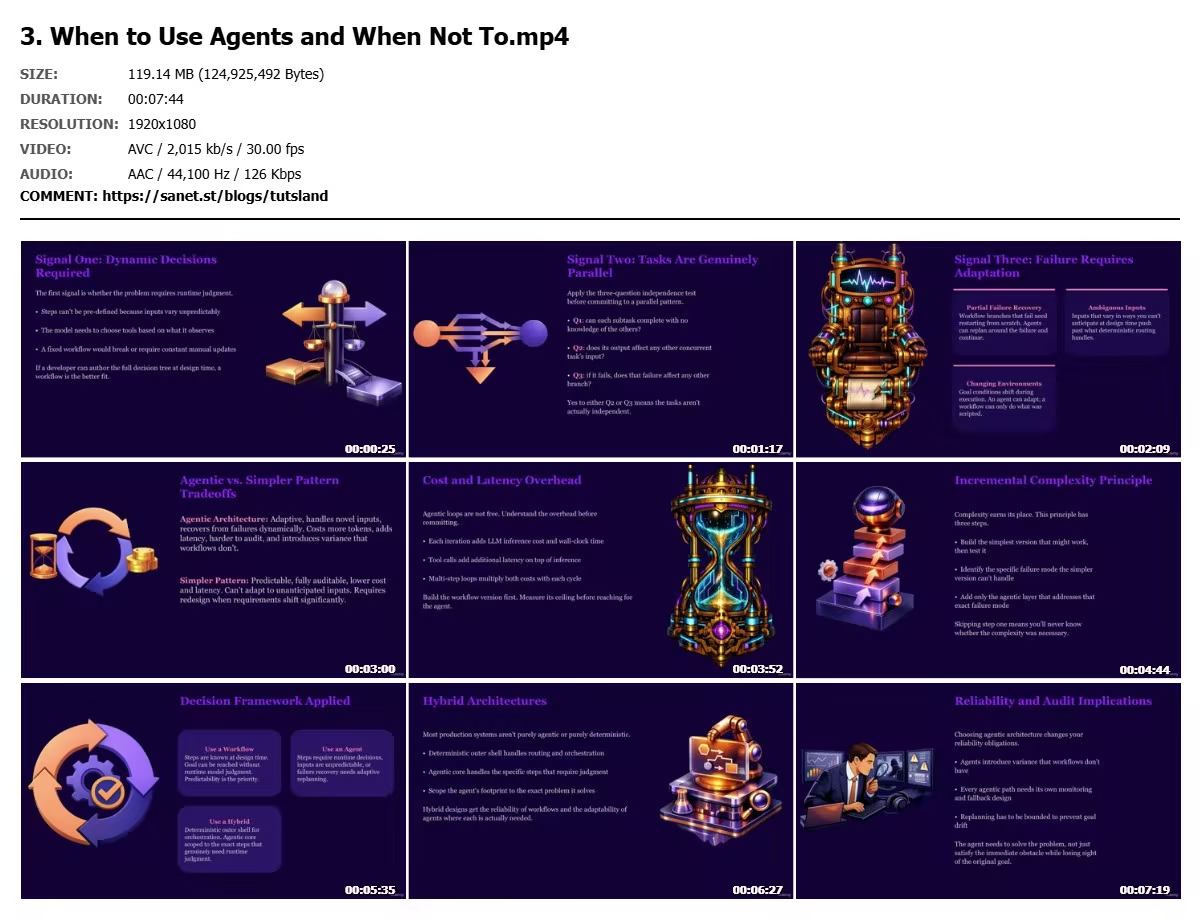
D1 — Agentic Architecture & Orchestration (27% of the exam) — covers defining agentic systems — autonomy, tool use, and the action loop, agents vs. workflows vs. conversational systems, when to use agentic architecture vs. simpler patterns, task analysis and decomposition strategies, sequential vs. parallel execution patterns, dynamic planning, replanning, and ambiguity handling, orchestrator-subagent model — roles, scope, and context isolation, multi-agent topology patterns — hub-and-spoke, pipeline, peer-to-peer, agent communication, handoff schemas, and error propagation, state and session management — in-context vs. external memory, error classification — tool, reasoning, and environment errors, fallback and retry strategies, programmatic enforcement vs. prompt-based guardrails, human-in-the-loop escalation design. You will understand how each of these areas is tested on the exam and how they connect to real-world practice.
D2 — Claude Code Configuration & Workflows (20% of the exam) — covers claude code architecture — tool system and execution model, project setup, context management, and session continuity, user, project, and team-level claudemd — hierarchy and precedence, path-specific rules, subdirectory config, and claudeignore, writing effective claudemd instructions for teams, custom slash commands — creation, structure, and distribution, skills — skillmd, frontmatter, triggers, and enterprise deployment, subagents in claude code — configuration, scope, and delegation, hooks — lifecycle events, implementation, and exit code conventions, useful hook patterns — logging, safety nets, and automation, claude code sdk — programmatic session control, ci/cd integration — non-interactive mode and the -p flag. You will understand how each of these areas is tested on the exam and how they connect to real-world practice.
D3 — Prompt Engineering & Structured Output (20% of the exam) — covers clarity, specificity, and instruction design, system prompts — structure, role definition, and context injection, xml tags and document structure for complex prompts, few-shot prompting and high-quality example design, chain-of-thought and extended thinking, prefilling, output steering, and format anchoring, temperature, top_p, top_k — generation parameter control, multi-turn conversation design and context accumulation, json mode and schema-constrained output, tool use for structured data extraction and validation loops, prompt evaluation — test datasets, grading, and regression testing. You will understand how each of these areas is tested on the exam and how they connect to real-world practice.
D4 — Tool Design & MCP Integration (18% of the exam) — covers tool descriptions as routing mechanisms, tool input schema design — parameters, enums, and constraints, tool error handling, idempotency, and partial success, mcp architecture — servers, clients, and the three primitives, building mcp servers — defining and exposing tools, resources and prompt templates in mcp, mcp clients — discovery, invocation, and multi-server routing, mcp transport mechanisms — stdio vs. streamablehttp, advanced mcp features — sampling, notifications, and roots, mcp security — access scoping, authentication, and production hardening. You will understand how each of these areas is tested on the exam and how they connect to real-world practice.
D5 — Context Management & Reliability (15% of the exam) — covers context window architecture — tokens, limits, and cost tradeoffs, the lost in the middle effect — evidence and mitigation, rag architecture — chunking, embedding, and the retrieval pipeline, semantic search, bm25, and hybrid retrieval, multi-index rag, production hardening, and citation, prompt caching — eligibility rules, cache placement, and cost impact, batch api — 50% cost savings, 24-hour window, and workload design, long-conversation coherence, compaction, and session memory. You will understand how each of these areas is tested on the exam and how they connect to real-world practice.
The included Exam Simulation is the honest version of readiness testing — scenario-heavy, just like the real exam. If you score well, you're ready. If you don't, the full course is built to close those gaps domain by domain. This course works as a standalone readiness check or as the final step in a complete study plan.
Major topics covered: defining agentic systems — autonomy, tool use, and the action loop, agents vs. workflows vs. conversational systems, when to use agentic architecture vs. simpler patterns, task analysis and decomposition strategies, sequential vs. parallel execution patterns, dynamic planning, replanning, and ambiguity handling, orchestrator-subagent model — roles, scope, and context isolation, multi-agent topology patterns — hub-and-spoke, pipeline, peer-to-peer, agent communication, handoff schemas, and error propagation, state and session management — in-context vs. external memory, error classification — tool, reasoning, and environment errors, fallback and retry strategies, programmatic enforcement vs. prompt-based guardrails, human-in-the-loop escalation design, claude code architecture — tool system and execution model, project setup, context management, and session continuity, user, project, and team-level claudemd — hierarchy and precedence, path-specific rules, subdirectory config, and claudeignore, writing effective claudemd instructions for teams, custom slash commands — creation, structure, and distribution, skills — skillmd, frontmatter, triggers, and enterprise deployment, subagents in claude code — configuration, scope, and delegation, hooks — lifecycle events, implementation, and exit code conventions, useful hook patterns — logging, safety nets, and automation, claude code sdk — programmatic session control, ci/cd integration — non-interactive mode and the -p flag, clarity, specificity, and instruction design, system prompts — structure, role definition, and context injection, xml tags and document structure for complex prompts, few-shot prompting and high-quality example design, CCA-F exam prep 2026.
Who this course is for
Software engineers and developers who build with the Claude API and want to validate their architectural knowledge with Anthropic's official CCA-F certification.
AI engineers and solutions architects designing agentic systems, multi-agent pipelines, or Claude Code workflows who want structured coverage of the full exam blueprint.
Technical leads and staff engineers evaluating Claude for production use who want a deep understanding of context management, tool use, safety, and cost optimization.
DevOps and platform engineers integrating Claude into CI/CD pipelines, developer tooling, or enterprise workflows who want to understand best practices at scale.
Product engineers and technical PMs who work closely with Claude-powered features and want to understand the architectural tradeoffs behind agentic system design.
Anyone preparing for the Anthropic CCA-F exam who wants a structured, instructor-led course covering all five exam domains with scenario-based practice questions.
Quick check before we show the links
Helps us keep automated scrapers from hammering the filehosts.