Basic Idea of Circular Motion and Rigid Body Rotation
Published 1/2025
MP4 | Video: h264, 1280x720 | Audio: AAC, 44.1 KHz, 2 Ch
Language: English | Duration: 3h 45m | Size: 4.92 GB
Circular Motion and an extension to Rigid Body Rotation
What you'll learn
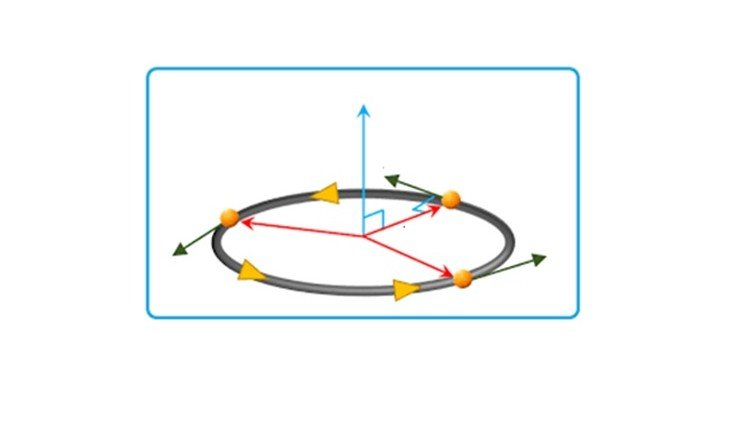
Point particle circular motion always occurs under centripetal force when subjected to rotating particle in radially inward sense at every instant of rotation.
Point particle circular motion is always an accelerated two dimensional motion of the rotating particle which may be of two types - uniform and non uniform.
For circular motion, the inertia of rotation is estimated by the moment of inertia and it is scalar for circular motion and a 2nd ranked tensor for rotation.
Rigid body rotation about any axis of rotation is the composition of a number of point particle circular motion about same axis of rotation with same ang speed.
Moment of inertia for rigid body rotation is a tensor of rank 2 with nine components out of which, 3 are normal moment of inertias and 6 are product of inertias
Requirements
Basic knowledge on Point Particle Circular Motion and after that knowledge on Rigid Body Rotation can be learned from this content
Description
Point particle circular motion is a two dimensional accelerated motion which occurs always under influence of centripetal force when applied on the rotating particle in radially inward sense at every moment of rotation of the particle. This circular motion may be of two types which are uniform circular motion and non uniform circular motion. Uniform circular motion occurs only under influence of centripetal force in which only direction of instantaneous velocity will change but for non uniform circular motion, two forces will be effective which are centripetal force and tangential force and for this kind of circular motion both magnitude and direction of the instantaneous velocity of the rotating particle will change. The most effective parameter for rotating particle in circular motion is moment of inertia which basically gives the rotational inertia of that particle. On the other hand if we consider the rigid body rotation about an axis of rotation then since a rigid body is a collection of a number of highly bound point particles, such rigid body rotation can be considered as the summation of a number of point particles circular motion about the same axis with the same angular speed. If we properly study such rigid body rotation and find the relation among the components of angular momentum with the component of angular speed then we can establish that the moment of inertia for rigid body rotation is not a scalar but it is a tensor of rank 2 which can be expressed by a 3x3 square matrix with 9 elements. Out of these 9 elements, 3 are the normal moment of inertia about the three conventional axes X, Y and Z axes and the remaining 6 elements are 6 product of inertias and these are zero for rotation about principal axes. If we consider the rolling of a circular body over the surface then that motion can be taken as the combination of rotational and translational motion and in that case the total energy of the whole combined motion can be expressed as the sum of energies of that two types of motion.
Who this course is for
Students at both beginner and advance level will be enriched by this content.

Quick check before we show the links
Helps us keep automated scrapers from hammering the filehosts.